

1
Ousmane Kouyaté - Kfeimba
2
Ousmane Kouyaté - N‘Ny
12” VINYL Limited Edition 180g - Comes with a Silk-Screen printed cover and a Pink colored vinyl
Born in 1952 in Dabola, Guinea, Ousmane was heir to the tradition of the Griots, the storytellers, poets and musicians who had served for centuries as the guardians of West African cultural heritage. He picked up the guitar and balafon in his early years and formed a youth band in his teens, but it was while studying agriculture at Kankan University that he decided to devote his life to music.
He moved to Bamako where he soon fell in with Mory Kanté and Les Ambassadeurs du Motel de Bamako, who were busy forging a modern Mandingue sound. He performed occasionally with the band and, when they finally broke up in 1977, he was asked to join guitarist Kanté Manfila and singer Salif Keita in a new venture. The newly-formed Les Ambassadeurs Internationaux relocated to Abidjan, where they came to the attention of legendary Beninese producer Badmos. Their electrifying first album, released in 1978, made them stars throughout West Africa.
After a few years of touring, Ousmane decided to focus on his own compositions and went to the esteemed JBZ Recording Studio in Abidjan. Accompanied by his fellow musicians from Les Ambassadeurs, Ousmane recorded “Kefimba” – named after the all-black bull from his childhood with whom he had shared his Manioc meals – and “N’Ny”; both were released initially on cassette before making their way to vinyl in 1982 and 1983.
Ousmane left Les Ambassadeurs shortly before their split in the mid-1980s, but he continued to work with Salif Keita, serving as his guitarist for more than three decades. After bringing their music to audiences throughout the world, the two friends eventually settled in France – for Ousmane it was the fulfilment of a lifelong aspiration.
Sicherheits- und Herstellerinformationen / safety and manufacturer info (GPSR)
WAS - Word and Sound Medien GmbH
Liebigstrasse 2-20
DE - 22113 Hamburg
Germany
Contact: [email protected]More
Born in 1952 in Dabola, Guinea, Ousmane was heir to the tradition of the Griots, the storytellers, poets and musicians who had served for centuries as the guardians of West African cultural heritage. He picked up the guitar and balafon in his early years and formed a youth band in his teens, but it was while studying agriculture at Kankan University that he decided to devote his life to music.
He moved to Bamako where he soon fell in with Mory Kanté and Les Ambassadeurs du Motel de Bamako, who were busy forging a modern Mandingue sound. He performed occasionally with the band and, when they finally broke up in 1977, he was asked to join guitarist Kanté Manfila and singer Salif Keita in a new venture. The newly-formed Les Ambassadeurs Internationaux relocated to Abidjan, where they came to the attention of legendary Beninese producer Badmos. Their electrifying first album, released in 1978, made them stars throughout West Africa.
After a few years of touring, Ousmane decided to focus on his own compositions and went to the esteemed JBZ Recording Studio in Abidjan. Accompanied by his fellow musicians from Les Ambassadeurs, Ousmane recorded “Kefimba” – named after the all-black bull from his childhood with whom he had shared his Manioc meals – and “N’Ny”; both were released initially on cassette before making their way to vinyl in 1982 and 1983.
Ousmane left Les Ambassadeurs shortly before their split in the mid-1980s, but he continued to work with Salif Keita, serving as his guitarist for more than three decades. After bringing their music to audiences throughout the world, the two friends eventually settled in France – for Ousmane it was the fulfilment of a lifelong aspiration.
Sicherheits- und Herstellerinformationen / safety and manufacturer info (GPSR)
WAS - Word and Sound Medien GmbH
Liebigstrasse 2-20
DE - 22113 Hamburg
Germany
Contact: [email protected]More
More records from Analog Africa
On 12 February 1949 an angry mob stormed into the centre of the Ecuadorian capital of Quito, burning the offices of the city’s main newspaper and its oldest radio station to the ground.
On that tragic day Radio Quito had just broadcast a local adaptation of H.G. Wells’s The War of the Worlds. The novel – first published in 1898 and famously adapted into a radio series by Orson Welles – is one of the earliest stories to depict a conflict between mankind and a hostile race of extra-terrestrials. The large audience - not understanding that it was pure fiction - believed that intergalactic intelligence had invaded the country as all hell broke loose. Thousands began running the streets of Quito looking for shelter, chaos broke out, causing a deadly stampede. People blamed the broadcaster for the tragedy, formed a dense crowd and stormed Radio Quito, setting it ablaze. Several musicians, who were there performing, were killed.
In the decades after the second world war, outer space was on everyone’s mind and the ‘space race’ of the 1950s and 60s not only produced groundbreaking efforts to launch artificial satellites, send space probes to Mars and land a human on the moon, it also had a huge impact on the movie and music industry which was taking advantage of the world‘s fascination with space voyages and lunar missions to create instruments capable of mimicking imaginary interstellar sounds. These synthesised space effects that captivated the imagination of a whole generation of young Ecuadoreans coincided with a period in which workers and musicians from the provinces started flocking to Quito and to the commercial port of Guayaquil, some hoping to find regular work, others looking to break into the musical big leagues by getting hired by one of the prestigious urban radio station. These artists brought riches of rhythms to the major Ecuadorian cities who would soon witness the explosion of what would be known as “Andean Cumbia”.
That fusion, of tropical electronics mixed in with Andean melodies and lyrics describing the cruel reality of migrant workers,
achieved massive success. And so while budding Ecuadorian UFOlogy lead to widespread extraterrestrial sightings, Ecuadorian musicians began released various albums consisting of traditional music combined with synthesisers in order to bring their traditional music into the space age. One of these musicians is Polibio Mayorga who had travelled 160km from his hometown of Chisalata to Quito where he showcased his talent as he championed the art of modernising his region’s ancestral rhythms - Huaynito, Sanjuanito, Albazo and many others - using the latest in electronic instruments.
After 4 years with Los Locos del Ritmo, one of Ecuador’s most popular bands, Polibio joined Fadisa (Fabrica De Discos S.A) in 1973 as a solo musician and songwriter before becoming their musical director a year later. While there he would team up with saxophonist extraordinaire Olmedo Torres, and for 10 years they would compose and arrange hits, not only for themselves but also for their fellow artists in the Fadisa family. Although Fadisa had countless labels in their roster, the jewel in their crown was Rondador and it was on that imprint that Polibio would release “Ponchito de Colores” and his famous album “La Farra Está Aquí”. With their novel use of Moog synthesiser, both become huge hit records and were broadcast constantly by Cosmopolita and Marañón de Quito – the two major radio stations of the capital. This led to a surge of interest in Andean cumbia, and the subsequent record sales helped to revive the country’s flagging music industry, turning Polibio into Ecuador’s most influential musician.
Polibio has never considered his music to be “tropical psychedelia” - although he thinks it would make a good name for a band. He has the sense of humour of a genius and the ability to make anyone laugh, yet he remains discreet, eloquent and humble … but as a musician he is daring and visionary, with an intrepid, vigorous style almost impossible to imitate. More than perhaps any of his peers, Polibio Mayorga established a unique place for himself at the vanguard of tropical music.
Tracklisting
1. America Índia 02:54
2. Muevase Vecina 02:13
3. Pañuelo De Seda 02:18
4. Altas Horas 02:11
5. Llorona 02:41
6. Haciendo Bomba 02:40
7. Mi Paisa 02:52
8. Culebrita Dormida 02:58
9. Muñequita Blanca 02:40
10. Unita Mas 02:20
11. Bomba de Pobres 02:30
12. Don Alfoncito 02:13
13. Ferrocarril 02:45
14. Di Que Me Amas 02:43
15. La Perra Vida 02:23
16. Cumbia Totorana 02:42
Sicherheits- und Herstellerinformationen / safety and manufacturer info (GPSR)
WAS - Word and Sound Medien GmbH
Liebigstrasse 2-20
DE - 22113 Hamburg
Germany
Contact: [email protected]More
On that tragic day Radio Quito had just broadcast a local adaptation of H.G. Wells’s The War of the Worlds. The novel – first published in 1898 and famously adapted into a radio series by Orson Welles – is one of the earliest stories to depict a conflict between mankind and a hostile race of extra-terrestrials. The large audience - not understanding that it was pure fiction - believed that intergalactic intelligence had invaded the country as all hell broke loose. Thousands began running the streets of Quito looking for shelter, chaos broke out, causing a deadly stampede. People blamed the broadcaster for the tragedy, formed a dense crowd and stormed Radio Quito, setting it ablaze. Several musicians, who were there performing, were killed.
In the decades after the second world war, outer space was on everyone’s mind and the ‘space race’ of the 1950s and 60s not only produced groundbreaking efforts to launch artificial satellites, send space probes to Mars and land a human on the moon, it also had a huge impact on the movie and music industry which was taking advantage of the world‘s fascination with space voyages and lunar missions to create instruments capable of mimicking imaginary interstellar sounds. These synthesised space effects that captivated the imagination of a whole generation of young Ecuadoreans coincided with a period in which workers and musicians from the provinces started flocking to Quito and to the commercial port of Guayaquil, some hoping to find regular work, others looking to break into the musical big leagues by getting hired by one of the prestigious urban radio station. These artists brought riches of rhythms to the major Ecuadorian cities who would soon witness the explosion of what would be known as “Andean Cumbia”.
That fusion, of tropical electronics mixed in with Andean melodies and lyrics describing the cruel reality of migrant workers,
achieved massive success. And so while budding Ecuadorian UFOlogy lead to widespread extraterrestrial sightings, Ecuadorian musicians began released various albums consisting of traditional music combined with synthesisers in order to bring their traditional music into the space age. One of these musicians is Polibio Mayorga who had travelled 160km from his hometown of Chisalata to Quito where he showcased his talent as he championed the art of modernising his region’s ancestral rhythms - Huaynito, Sanjuanito, Albazo and many others - using the latest in electronic instruments.
After 4 years with Los Locos del Ritmo, one of Ecuador’s most popular bands, Polibio joined Fadisa (Fabrica De Discos S.A) in 1973 as a solo musician and songwriter before becoming their musical director a year later. While there he would team up with saxophonist extraordinaire Olmedo Torres, and for 10 years they would compose and arrange hits, not only for themselves but also for their fellow artists in the Fadisa family. Although Fadisa had countless labels in their roster, the jewel in their crown was Rondador and it was on that imprint that Polibio would release “Ponchito de Colores” and his famous album “La Farra Está Aquí”. With their novel use of Moog synthesiser, both become huge hit records and were broadcast constantly by Cosmopolita and Marañón de Quito – the two major radio stations of the capital. This led to a surge of interest in Andean cumbia, and the subsequent record sales helped to revive the country’s flagging music industry, turning Polibio into Ecuador’s most influential musician.
Polibio has never considered his music to be “tropical psychedelia” - although he thinks it would make a good name for a band. He has the sense of humour of a genius and the ability to make anyone laugh, yet he remains discreet, eloquent and humble … but as a musician he is daring and visionary, with an intrepid, vigorous style almost impossible to imitate. More than perhaps any of his peers, Polibio Mayorga established a unique place for himself at the vanguard of tropical music.
Tracklisting
1. America Índia 02:54
2. Muevase Vecina 02:13
3. Pañuelo De Seda 02:18
4. Altas Horas 02:11
5. Llorona 02:41
6. Haciendo Bomba 02:40
7. Mi Paisa 02:52
8. Culebrita Dormida 02:58
9. Muñequita Blanca 02:40
10. Unita Mas 02:20
11. Bomba de Pobres 02:30
12. Don Alfoncito 02:13
13. Ferrocarril 02:45
14. Di Que Me Amas 02:43
15. La Perra Vida 02:23
16. Cumbia Totorana 02:42
Sicherheits- und Herstellerinformationen / safety and manufacturer info (GPSR)
WAS - Word and Sound Medien GmbH
Liebigstrasse 2-20
DE - 22113 Hamburg
Germany
Contact: [email protected]More
Put your dancing shoes and be ready to kill the dancefloor, the intoxicating highlife music known as Edo Funk from Benin City, Nigeria is back. Following the planetary success of our „Edo Funk Explosion Vol.1“ project we have now unearthed „No Food Without Taste If By Hunger“ by „The Good Samaritans“, one of the most obscure Nigerian album ever recorded. Originally released in 1982, the bands first album is full of bouncy basslines, raw trance-like grooves and tripped-out psychedelic guitars, a funk experience unlike any other.
„The Good Samaritans“ is Philosopher Okundaye’s own Edo-Funk project, under which name he produced four albums, all recorded at Phonodisk Studio in Ijebu-Igbo east of Lagos with a 24 track. Okundaye who played many instruments, engaged the right musicians for each project and mixed the whole thing himself, is known as the composer of a large part of Benin City’s celebrated hits in the 80s. His name keeps popping up but somehow his role in the scene remains a bit hazy, giving the character an image of something like the gray eminence of Edo funk.
Due to its private pressing in a probably very small edition, „No Food Without Taste If By Hunger“ is very difficult to find. With this reissue limited to 2000 copies - newly mastered by Nick Robbins and approved by Philosopher Okundaye himself - „The Good Samaritans“ make a welcome and long-overdue return to turntables around the world in a beautiful Silk-Screen printed cover and an orange colored vinyl pressed on 180g high quality vinyl. This is funk stripped down to its primal essence, driving rhythms mixed with highlife horns, sweet keyboards and psychedelic guitar riffs, pushing the limits of dance moves towards cosmic dancefloors.
Listen & Enjoy!
https://on.soundcloud.com/xTchT
Tracklisting
Side A
1. Onughara - The Good Samaritans 05:04
2. Ughamwen-Rhienenemwen- The Good Samaritans 04:32
3. Ekhueghamunu - The Good Samaritans 06:27
Side B
4. Gaskya-Kace - The Good Samaritans 05:40
5. Bi Enu Ba Sahun - The Good Samaritans 05:43
6. Aikemienaru-Nanorunomwan - The Good Samaritans 07:32
*No Food Without Taste If By Hunger* comes as a Limited Edition LP with a Silk-Screen printed cover and an orange colored vinyl pressed on 180g high quality vinyl
Sicherheits- und Herstellerinformationen / safety and manufacturer info (GPSR)
WAS - Word and Sound Medien GmbH
Liebigstrasse 2-20
DE - 22113 Hamburg
Germany
Contact: [email protected]More
„The Good Samaritans“ is Philosopher Okundaye’s own Edo-Funk project, under which name he produced four albums, all recorded at Phonodisk Studio in Ijebu-Igbo east of Lagos with a 24 track. Okundaye who played many instruments, engaged the right musicians for each project and mixed the whole thing himself, is known as the composer of a large part of Benin City’s celebrated hits in the 80s. His name keeps popping up but somehow his role in the scene remains a bit hazy, giving the character an image of something like the gray eminence of Edo funk.
Due to its private pressing in a probably very small edition, „No Food Without Taste If By Hunger“ is very difficult to find. With this reissue limited to 2000 copies - newly mastered by Nick Robbins and approved by Philosopher Okundaye himself - „The Good Samaritans“ make a welcome and long-overdue return to turntables around the world in a beautiful Silk-Screen printed cover and an orange colored vinyl pressed on 180g high quality vinyl. This is funk stripped down to its primal essence, driving rhythms mixed with highlife horns, sweet keyboards and psychedelic guitar riffs, pushing the limits of dance moves towards cosmic dancefloors.
Listen & Enjoy!
https://on.soundcloud.com/xTchT
Tracklisting
Side A
1. Onughara - The Good Samaritans 05:04
2. Ughamwen-Rhienenemwen- The Good Samaritans 04:32
3. Ekhueghamunu - The Good Samaritans 06:27
Side B
4. Gaskya-Kace - The Good Samaritans 05:40
5. Bi Enu Ba Sahun - The Good Samaritans 05:43
6. Aikemienaru-Nanorunomwan - The Good Samaritans 07:32
*No Food Without Taste If By Hunger* comes as a Limited Edition LP with a Silk-Screen printed cover and an orange colored vinyl pressed on 180g high quality vinyl
Sicherheits- und Herstellerinformationen / safety and manufacturer info (GPSR)
WAS - Word and Sound Medien GmbH
Liebigstrasse 2-20
DE - 22113 Hamburg
Germany
Contact: [email protected]More
In 2010, I had asked Eamon Ore-Giron - aka DJ Lengua - if he would be interested in compiling a Latin project for Analog Africa, and if so, if he had a theme in mind. He replied, “Have you ever heard of rebajada?“ The question mark above my head, together with the wall of China, must have been the only other object visible from out of space because Eamon, probably noticing I got paralysed, continued, “Rebajada in Spanish means “to reduce, to lower”. It’s basically Mexican sonideros (sound-system operators) slowing down the beat of a Cumbia to create a much more tangible music to dance to. I’ll send you a mix I made last year and let me know what you think.“ And so he did.
That mix was called Rebajada Mota Mix and I began listening to it on a loop. Although I was not immediately hooked it was intriguing from the get-go, and so I kept listening until magic began unfolding. Slowed down music allows you enough time to hear right through it, revealing itself in ways I had rarely experienced before. Everything became more transparent and I was noticing sounds normally only perceptible by bats. A near psychedelic experience. That mysterious mix included a few Ecuadorian songs by Junior y su Equipo - aka Polibio Mayorga (a cult figure in the sonidero scene), a couple of Mexican tunes, one Colombian, and various Peruvian songs, undoubtedly the driving force behind this project.
The sonidero who brought Peruvian and Ecuadorian music to Mexico was the legendary Pablo Perea from Sonido Arco-Iris, and although his fingerprints are all over the compilation Saturno 2000, this selection of songs in rebajada is exclusive to DJ Lengua. With the exception of a few classics from Polibio Mayorga and La Sampuesana – the queen of all rebajadas – most of these songs were probably never performed as such before, let alone released.
So how did rebajada come to be? In a nutshell; Rebajada started with two families of brothers – the Pereas and the Ortegas –
who travelled all over Latin America and returned to Mexico with heavy loads of records which they would sell to the various sonideros always on the lookout for new tunes. Colombian beats especially seemed to fit almost perfectly with the Mexican dance steps – but they were just a bit too fast. As a result some sonideros began experimenting with equipment, and Marco Antonio Cedillo of Sonido Imperial created a revolutionary pitching system that could slow records down to an extent other players could only dream about. And so rebajada was born . . . or so we thought.
At the same time in north of the country, in Monterrey, sonidero Gabriel Dueñez almost got electrocuted by a short circuit that nearly set his record player on fire. As a result the platter started spinning in slow motion for the rest of the party, turning Cumbia into a different affair altogether. The youngsters went crazy for it and started harassing the sonidero with requests to record cassettes for them. Reluctant at first, Dueñez finally began recording a series of pirated cassettes called “Rebajada” which included mainly Colombian cumbia and porro in slow-mo exclusively. Those tapes took the city by storm and turned rebajada into a celebrated and defiant movement of the youth.
Of course it would not be a Mexican urban legend if it didn’t include dramaturgical elements, and so for nearly 30 years, until this day and probably for ever, both cities have been arguing and claiming ownership the creation of rebajada for themselves. But sonidera Joyce Musicolor, who never has time for such trivial arguments, got straight to the point: “Rebajada, and the equipment to perform it, is from here [Mexico City] but it was Monterrey that popularised it.“
Double LP pressed on 140g virgin vinyl comes with a full color 12-pages booklet
Tracklisting
A1. Sampuesana - Los Dinners 03:55
A2. La Borrachita - Junior Y Su Equipo 02:32
A3. Paga La Cuenta Sinverguenza - Manzanita 04:58
A4. Infinito - Hugo Blanco Y Su Arpa Viajera 03:36
B1. El Jardinero (only LP and CD) - Manzanita Y Su Conjunto 03:56
B2. Feito Parrandero - Los Feos 03:40
B3. Bien Bailadito - Junior Y Su Equipo 04:15
B4. Saturno 2000 - Los Santos 03:41
C1. La Danza Del Mono - Lucho Gavilanes 03:20
C2. Capricho Egipcio - Conjunto Típico Contreras 03:20
C3. El Chacarero - Los Gatos Blancos 03:22
C4. Pa‘ Oriente Me Voy - Los Atomos de Paramonga 04:25
D1. Alegrate - Junior Y Su Equipo 03:01
D2. Todo Lo Tengo De Ti Menos Tu Amor - Grupo Celeste 04:48
D3. La Fuga Del Bandido - Los Ecos 05:02
Sicherheits- und Herstellerinformationen / safety and manufacturer info (GPSR)
WAS - Word and Sound Medien GmbH
Liebigstrasse 2-20
DE - 22113 Hamburg
Germany
Contact: [email protected]More
That mix was called Rebajada Mota Mix and I began listening to it on a loop. Although I was not immediately hooked it was intriguing from the get-go, and so I kept listening until magic began unfolding. Slowed down music allows you enough time to hear right through it, revealing itself in ways I had rarely experienced before. Everything became more transparent and I was noticing sounds normally only perceptible by bats. A near psychedelic experience. That mysterious mix included a few Ecuadorian songs by Junior y su Equipo - aka Polibio Mayorga (a cult figure in the sonidero scene), a couple of Mexican tunes, one Colombian, and various Peruvian songs, undoubtedly the driving force behind this project.
The sonidero who brought Peruvian and Ecuadorian music to Mexico was the legendary Pablo Perea from Sonido Arco-Iris, and although his fingerprints are all over the compilation Saturno 2000, this selection of songs in rebajada is exclusive to DJ Lengua. With the exception of a few classics from Polibio Mayorga and La Sampuesana – the queen of all rebajadas – most of these songs were probably never performed as such before, let alone released.
So how did rebajada come to be? In a nutshell; Rebajada started with two families of brothers – the Pereas and the Ortegas –
who travelled all over Latin America and returned to Mexico with heavy loads of records which they would sell to the various sonideros always on the lookout for new tunes. Colombian beats especially seemed to fit almost perfectly with the Mexican dance steps – but they were just a bit too fast. As a result some sonideros began experimenting with equipment, and Marco Antonio Cedillo of Sonido Imperial created a revolutionary pitching system that could slow records down to an extent other players could only dream about. And so rebajada was born . . . or so we thought.
At the same time in north of the country, in Monterrey, sonidero Gabriel Dueñez almost got electrocuted by a short circuit that nearly set his record player on fire. As a result the platter started spinning in slow motion for the rest of the party, turning Cumbia into a different affair altogether. The youngsters went crazy for it and started harassing the sonidero with requests to record cassettes for them. Reluctant at first, Dueñez finally began recording a series of pirated cassettes called “Rebajada” which included mainly Colombian cumbia and porro in slow-mo exclusively. Those tapes took the city by storm and turned rebajada into a celebrated and defiant movement of the youth.
Of course it would not be a Mexican urban legend if it didn’t include dramaturgical elements, and so for nearly 30 years, until this day and probably for ever, both cities have been arguing and claiming ownership the creation of rebajada for themselves. But sonidera Joyce Musicolor, who never has time for such trivial arguments, got straight to the point: “Rebajada, and the equipment to perform it, is from here [Mexico City] but it was Monterrey that popularised it.“
Double LP pressed on 140g virgin vinyl comes with a full color 12-pages booklet
Tracklisting
A1. Sampuesana - Los Dinners 03:55
A2. La Borrachita - Junior Y Su Equipo 02:32
A3. Paga La Cuenta Sinverguenza - Manzanita 04:58
A4. Infinito - Hugo Blanco Y Su Arpa Viajera 03:36
B1. El Jardinero (only LP and CD) - Manzanita Y Su Conjunto 03:56
B2. Feito Parrandero - Los Feos 03:40
B3. Bien Bailadito - Junior Y Su Equipo 04:15
B4. Saturno 2000 - Los Santos 03:41
C1. La Danza Del Mono - Lucho Gavilanes 03:20
C2. Capricho Egipcio - Conjunto Típico Contreras 03:20
C3. El Chacarero - Los Gatos Blancos 03:22
C4. Pa‘ Oriente Me Voy - Los Atomos de Paramonga 04:25
D1. Alegrate - Junior Y Su Equipo 03:01
D2. Todo Lo Tengo De Ti Menos Tu Amor - Grupo Celeste 04:48
D3. La Fuga Del Bandido - Los Ecos 05:02
Sicherheits- und Herstellerinformationen / safety and manufacturer info (GPSR)
WAS - Word and Sound Medien GmbH
Liebigstrasse 2-20
DE - 22113 Hamburg
Germany
Contact: [email protected]More
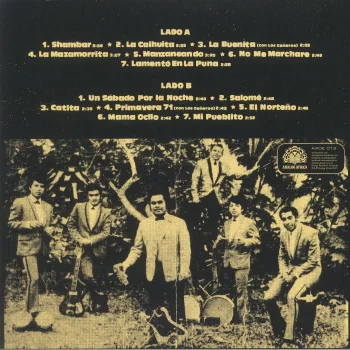
1
Manzanita Y Su Conjunto - Shambar
2
Manzanita Y Su Conjunto - La Caihuita
3
Manzanita Y Su Conjunto - La Buenita (Con Los Caneros)
4
Manzanita Y Su Conjunto - La Mazamorrita
5
Manzanita Y Su Conjunto - Manzaneando
6
Manzanita Y Su Conjunto - No Me Marchare
7
Manzanita Y Su Conjunto - Lamento En La Puna
8
Manzanita Y Su Conjunto - Un Sabado Por La Noche
9
Manzanita Y Su Conjunto - Salome
10
Manzanita Y Su Conjunto - Catita
11
Manzanita Y Su Conjunto - Primavera 71 (Con Los Caneros)
12
Manzanita Y Su Conjunto - El Norteno
13
Manzanita Y Su Conjunto - Mama Ocllo
14
Manzanita Y Su Conjunto - Mi Pueblito
I was in Lima, hanging out with collector-extraordinaire Victor Zela, who had spent the previous few years pouring his passion for Peruvian Cumbia into the blog „la cumbia de mis viejos“, a trove of incredible music. But after the birth of his first child, his priorities shifted and he decided to part with some of his rarest LPs. I was one of the lucky few given an early chance to examine his treasures, and when I picked up the album Manzaneando com Manzanita, Victor said: “Take it! its one of the best LPs ever recorded in Perú … easily in the top five”. That was all the encouragement I needed … two years later many of the songs from that masterpiece have made it onto Manzanita y su Conjunto, a compilation of electrifying Cumbia sides from Manzanita’s golden era.
Berardo Hernández – better known as Manzanita – first surfaced during the psychedelic Cumbia craze. At the head of the scene were the magnificent Los Destellos, whose leader, Enrique Delgado, was such a six-string wizard that other guitarists found it impossible to escape his shadow. But when Manzanita arrived, his electric criollo style sent shockwaves through Lima’s music scene and posed a serious threat to Delgado’s dominance as king of the Peruvian guitar.
Manzanita had come to Lima from the coastal city of Trujillo, five hundred miles up the coast – a place where Spanish, African and indigenous populations had been living and making music together for centuries – and came of age at a time when the first wave of psychedelic rock from the US and UK was starting to sweep the airwaves. But the sounds of Cream and Hendrix disappeared from the radio just as quickly in 1968 when Juan Velasco seized control of the country in a military coup. The new regime, which favoured local traditions over cultural ‘imports’ from the north, was a blessing in disguise for the Peruvian music scene.
Record labels flourished as new bands, raised on a hybrid diet of electric guitars and Cuban rhythms, rushed in to fill the vacuum created by the lack of imported rock. A new genre, known as Peruvian cumbia, was born and Manzanita quickly became one of its most original voices.
Starting in 1969, Manzanita y su Conjunto released a steady stream of singles that used Cuban guaracha rhythms as the foundation for dazzling electric guitar lines. After countless 45s and several years on the touring circuit, the band signed to Virrey, an important Peruvian label, and recorded two LPs acknowledged as masterpieces among aficionados of tropical music. Most of the songs on Analog Africa’s new compilation Manzanita y su Conjunto are drawn from those legendary sessions of 1973 and 74.
Although he scored a few more hits in the later 70s, his dissatisfaction with the music industry caused him to withdraw from the scene for several years; and when he finally retired for good, the golden age of Peruvian cumbia was a distant memory. But when Manzanita was at the top of his game he had few equals. Victor Zela was right: this is some of the best music ever recorded in Perú.
Tracklisting
1. Shambar 2:56
2. La Caihuita 2:55
3. La Buenita (con Los Cañeros) 2:05
4. La Mazamorrita 3:07
5. Manzaneando 3:20
6. No Me Marchare 2:49
7. Lamentó En La Puna 2:58
8. Un Sábado Por la Noche 2:40
9. Salomé 2:48
10. Catita 2:35
11. Primavera 71 (con Los Cañeros) 2:42
12. El Norteño 2:46
13. Mama Ocllo 2:42
14. Mi Pueblito 2:52
Sicherheits- und Herstellerinformationen / safety and manufacturer info (GPSR)
WAS - Word and Sound Medien GmbH
Liebigstrasse 2-20
DE - 22113 Hamburg
Germany
Contact: [email protected]More
Berardo Hernández – better known as Manzanita – first surfaced during the psychedelic Cumbia craze. At the head of the scene were the magnificent Los Destellos, whose leader, Enrique Delgado, was such a six-string wizard that other guitarists found it impossible to escape his shadow. But when Manzanita arrived, his electric criollo style sent shockwaves through Lima’s music scene and posed a serious threat to Delgado’s dominance as king of the Peruvian guitar.
Manzanita had come to Lima from the coastal city of Trujillo, five hundred miles up the coast – a place where Spanish, African and indigenous populations had been living and making music together for centuries – and came of age at a time when the first wave of psychedelic rock from the US and UK was starting to sweep the airwaves. But the sounds of Cream and Hendrix disappeared from the radio just as quickly in 1968 when Juan Velasco seized control of the country in a military coup. The new regime, which favoured local traditions over cultural ‘imports’ from the north, was a blessing in disguise for the Peruvian music scene.
Record labels flourished as new bands, raised on a hybrid diet of electric guitars and Cuban rhythms, rushed in to fill the vacuum created by the lack of imported rock. A new genre, known as Peruvian cumbia, was born and Manzanita quickly became one of its most original voices.
Starting in 1969, Manzanita y su Conjunto released a steady stream of singles that used Cuban guaracha rhythms as the foundation for dazzling electric guitar lines. After countless 45s and several years on the touring circuit, the band signed to Virrey, an important Peruvian label, and recorded two LPs acknowledged as masterpieces among aficionados of tropical music. Most of the songs on Analog Africa’s new compilation Manzanita y su Conjunto are drawn from those legendary sessions of 1973 and 74.
Although he scored a few more hits in the later 70s, his dissatisfaction with the music industry caused him to withdraw from the scene for several years; and when he finally retired for good, the golden age of Peruvian cumbia was a distant memory. But when Manzanita was at the top of his game he had few equals. Victor Zela was right: this is some of the best music ever recorded in Perú.
Tracklisting
1. Shambar 2:56
2. La Caihuita 2:55
3. La Buenita (con Los Cañeros) 2:05
4. La Mazamorrita 3:07
5. Manzaneando 3:20
6. No Me Marchare 2:49
7. Lamentó En La Puna 2:58
8. Un Sábado Por la Noche 2:40
9. Salomé 2:48
10. Catita 2:35
11. Primavera 71 (con Los Cañeros) 2:42
12. El Norteño 2:46
13. Mama Ocllo 2:42
14. Mi Pueblito 2:52
Sicherheits- und Herstellerinformationen / safety and manufacturer info (GPSR)
WAS - Word and Sound Medien GmbH
Liebigstrasse 2-20
DE - 22113 Hamburg
Germany
Contact: [email protected]More
Sicherheits- und Herstellerinformationen / safety and manufacturer info (GPSR)
WAS - Word and Sound Medien GmbH
Liebigstrasse 2-20
DE - 22113 Hamburg
Germany
Contact: [email protected]More
Sicherheits- und Herstellerinformationen / safety and manufacturer info (GPSR)
WAS - Word and Sound Medien GmbH
Liebigstrasse 2-20
DE - 22113 Hamburg
Germany
Contact: [email protected]More
Sicherheits- und Herstellerinformationen / safety and manufacturer info (GPSR)
WAS - Word and Sound Medien GmbH
Liebigstrasse 2-20
DE - 22113 Hamburg
Germany
Contact: [email protected]More
New compilation with 14 funky tracks by the legendary ensemble from Benin that has been deemed as “West-Africa’s best kept secret,” or as the “The D.N.A. of voodoo groove”. Following two previous Poly-Rythmo collections released by multiple award winner label Analog Africa – “The Vodoun Effect” (2008) and “Echos Hypnotiques” (2009) – this third compilation is another proof that our ears are facing “One of the Funkiest bands in the world”.? TIP!! Starting in 2005, Samy Ben Redjeb, Analog Africa’s founder and compiler, made several trips to Benin, where he dug up most of the orchestra’s output recorded between 1969 and 1983: hundreds of vinyl records and a few master tapes, in a total of 500 songs! With all that material in hands and the astonishing richness of the group’s meterial, choosing the songs proved to be a tough task. Therefore, it seems only natural that it has taken a few years for this third volume to come out of Analog Africa´s sonic treasure trove.?? The 14 tracks presented here have never been issued outside of Africa and most of them follow the spirit and sound of the first volume, “The Vodoun Effect,” which was a selection of songs released by small and obscure labels from this tiny country which was once known as Dahomey. Some of the songs presented here were recorded using a legendary piece of equipment, a Swiss made Nagra reel-to-reel recorder and one or two microphones, in private houses or open air gardens, mostly at night. And still, it would be somewhat difficult for contemporary musicians and engineers to achieve the stunning quality of raw sound and the atmosphere obtained in these recordings, even if they booked the most modern and expensive studios out there today.?? One thing that immediately catches the attention listening to this compilation is the band’s steamroller-like grooves employed by Gustave Bentho, the mythical bass master, and Leopold Yehouessi , the fantastic drummer of the band – for many, Africa´s funkiest rhythm sections. The power lying in these tunes is phenomenal and shows true craftsmanship on both the composition and the production side, “Houton Kan Do Gome”, composed by Bentho, would have made James Brown proud. “Ecoutes ma Melodie” is destined to become a classical late night tune for the many amazing tropical and afro parties taking place around the globe. “Pourquoi Pas?” and “A O O Ida” would be the kind of sound The Meters would have created were they born in Benin. ?? On December 17th, 2012, only a few months before this release, Melome Clement, the man who formed the all-powerful orchestra, passed away victim of a heart attack. ?The “boss,” as the other band members would tenderly call him, will be missed, but not forgotten. The soul of the music he created has permanently engraved itself in the soil of Benin. Check out his amazing original video of Orchestre Poly-Rythmo de Cotonou performing "Houzou Houzou Wa" (Track 2 from the new compilation) for the Beninese State (ORTB) television in 1978 : https://www.youtube.com/watch?feature=player_embedded&v=9SfFT3ie-ok
Sicherheits- und Herstellerinformationen / safety and manufacturer info (GPSR)
WAS - Word and Sound Medien GmbH
Liebigstrasse 2-20
DE - 22113 Hamburg
Germany
Contact: [email protected]More
Sicherheits- und Herstellerinformationen / safety and manufacturer info (GPSR)
WAS - Word and Sound Medien GmbH
Liebigstrasse 2-20
DE - 22113 Hamburg
Germany
Contact: [email protected]More
Customers who bought this also bought this
non-exclusive
2LP R&S and Apollo Records present an official vinyl repress of this most classicand timeless album The vinyl uses the 2013 re-masters made from original DAT tapes cut by Matt Colton and presented in original artwork.
All time favourite Aphex Twin Album. Nice and accesible experimental techno. Originally released in 1992. What else could be said here, we finally are stocking copies on arguably the most important and influential electronic album of album time, Aphex Twin's Selected Ambient Works 85–92. You will always need this!!!
Tracks: A1 Xtal
A2 Tha
A3 Pulsewidth
B1 Ageispolis
B2 i
B3 Green Calx
B4 Heliosphan
C1 We Are The Music Makers
C2 Schottkey 7th Path
C3 Ptolemy
D1 Hedphelym
D2 Delphium
D3 Actium
Sicherheits- und Herstellerinformationen / safety and manufacturer info (GPSR)
WAS - Word and Sound Medien GmbH
Liebigstrasse 2-20
DE - 22113 Hamburg
Germany
Contact: [email protected]More
2LP R&S and Apollo Records present an official vinyl repress of this most classicand timeless album The vinyl uses the 2013 re-masters made from original DAT tapes cut by Matt Colton and presented in original artwork.
All time favourite Aphex Twin Album. Nice and accesible experimental techno. Originally released in 1992. What else could be said here, we finally are stocking copies on arguably the most important and influential electronic album of album time, Aphex Twin's Selected Ambient Works 85–92. You will always need this!!!
Tracks: A1 Xtal
A2 Tha
A3 Pulsewidth
B1 Ageispolis
B2 i
B3 Green Calx
B4 Heliosphan
C1 We Are The Music Makers
C2 Schottkey 7th Path
C3 Ptolemy
D1 Hedphelym
D2 Delphium
D3 Actium
Sicherheits- und Herstellerinformationen / safety and manufacturer info (GPSR)
WAS - Word and Sound Medien GmbH
Liebigstrasse 2-20
DE - 22113 Hamburg
Germany
Contact: [email protected]More
1
Upit Sarimanah - Tumbila Di Adu Boksen
2
Upit Sarimanah - Sambatan Sakadang Kuja
3
Upit Sarimanah - Pantja Sila
4
Upit Sarimanah - Tjiandjur
5
Upit Sarimanah - Haleuang Abdi
6
Upit Sarimanah - Kitjir-Kitjir
7
Upit Sarimanah - Oraj Welang
8
Upit Sarimanah - Tjikapundung
9
Upit Sarimanah - Kunaon Neuteup Ka Abdi
10
Upit Sarimanah - Kongkorongok Hajam
11
Upit Sarimanah - Order Baru
12
Upit Sarimanah - Maling Tjabe
Upit Sarimanah's self-titled album is here, a captivating collection of songs that reimagined what Sundanese music really means. Originally released by Mesra Records, it finally got repressed by LaMunai Records after out of circulation for decades. Born Suryamah on April 16, 1928, in Sadang, Purwakarta, Upit Sarimanah was a famous Indonesian singer, particularly known for her traditional Sundanese songs in the 1950s. She was a prominent figure at RRI Jakarta from 1950 to 1984 and also led the Gamelan Siliwangi.
Sicherheits- und Herstellerinformationen / safety and manufacturer info (GPSR)
WAS - Word and Sound Medien GmbH
Liebigstrasse 2-20
DE - 22113 Hamburg
Germany
Contact: [email protected]More
Sicherheits- und Herstellerinformationen / safety and manufacturer info (GPSR)
WAS - Word and Sound Medien GmbH
Liebigstrasse 2-20
DE - 22113 Hamburg
Germany
Contact: [email protected]More
1
Lay-Far Dance Orchestra - Take Flight (Part 1)
2
Lay-Far Dance Orchestra - Aquarius Love Feat. Seven Davis Jr
3
Lay-Far Dance Orchestra - Head In The Clouds
4
Lay-Far Dance Orchestra - Where You From
5
Lay-Far Dance Orchestra - The Harp Of Boom
6
Lay-Far Dance Orchestra - Feel The Moment Feat. Antoha MC
7
Lay-Far Dance Orchestra - Take Flight (Part 2)
8
Lay-Far Dance Orchestra - Soul Constant
9
Lay-Far Dance Orchestra - Where You From (Lipelis Vision)
10
Lay-Far Dance Orchestra - No Title
DJ Support: Garnier, Opolopo, Worldwide FM, Marcia Carr, Bill Brewster, Timeout Moscow, Craig Smith, Delfonic, Tony Nwachukwu, Marcel Dettmann, DJ Rocca, Shuya Okino, Borrowed Identity, Titonton Duvante, Alex Attias, Rainer Truby, Sol Power All-Stars, Kyri R2, Robert Luis, Severino Panzetta, Lars Behrenroth, Kassian, Alkalino, Getdown Edits, Moodymanc, Gerd, Lea Lisa, Young Pulse, Mark de Clive-Lowe, Mark Grusane, Alex Barck….
International dance music heavyweight, producer and DJ Alexander Lay-Far returns with a powerful new chapter - Lay-Far Dance Orchestra (LFDO) - a fully-fledged live band project that reconnects him with his jazz-funk and fusion DNA while pushing dance music forward with unmistakable groove, musicianship and emotional weight. Formed in early 2024, LFDO is no nostalgia exercise. With Lay-Far at the helm as bassist, bandleader, composer, arranger and sound engineer, the orchestra has already been turning heads with explosive live performances, reinventing classic Lay-Far cuts, and now unveil their first album “Skybreak” with all new and original material written and produced by Lay-Far together with his bandmates and star guests, including Lipelis, Antoha MC and Seven Davis Jr. This work shows the departure from the predominantly electronic sound of Lay-Far's previous solo albums in favour of live instrumentation recorded to analogue tape and effortlessly bridging the gap between Jazz, Library Music, Disco-Funk, House, Broken Beat and Drum’n’Bass. “Skybreak” is dynamic, passionate, spiritual, cinematic, playful, heartfelt, life-affirming, dreamy and deeply romantic. Ultimately, there’s something profoundly romantic in recording and releasing such music in this day and age!
“Take Flight (Part 1)” is opening the album with style. It takes us on a beautifully orchestrated journey, blending the sensuality of Library Music with high-octane Jazz-Funk and raw b-boy breaks, propelled by breathtaking flute and Rhodes solos of Timur Nekrasov and Maxim Glonti. This aural symbiosis of “beauty and the beats” will become more and more prominent as the album unfolds.
It’s time for “Aquarius Love” created with the inimitable artist and vocalist Seven Davis Jr. (Secret Angels, Ninja Tune). In this composition cinematic soul and heavy jazz meet the restless energy of live drum & bass with deep and heartfelt vocals - timeless sound combined with a timeless message about love and life!
Next is “Head In The Clouds” - a theme for an imaginary rom-com, an ode to all the dreamers - sweet, light, naive and heartwarming. Space-Disco-Funk at its best!
“Where You From” is a fiery Soulful House number with heavy Afro-Latin influences recorded in collaboration with Lipelis. It’s full of Sun, joy and passion. Its irresistible rhythm is emphasised by funky octave bass, wah-wah guitar, catchy piano riffs, guitar solo by Lipelis and seemingly light conscious message delivered by Lay-Far and Maryag. Summer is here!
Now the album takes an unexpected twist in the form of “The Harp of Boom” which at first glance appears to be a classic-sounding Boom-Bap banger. Yes, It’s loud, raw, and gritty, yet it gradually evolves into something delicately-touching and deeply-soulful thanks to a memorable flute melody and lush string arrangement. Definitely recorded with tongue in cheek.
Next is “Feel The Moment” a remarkable collaboration with one of the most recognisable and distinctive Russian artists, singer, trumpeter and cultural icon Antoha MC. It’s a feel-good song, hopeful, life-affirming and bittersweet. A stylish excursion into Brit-Funk and Soviet Jazz-Fusion sound, drawing inspiration from the likes of Atmosfear, Light Of The World or Soviet Jazz bands like Allegro and Arsenal, but reimagining the influences through the modern West London broken beat lens.
The spectacular music journey continuous with “Take Flight (Part 2)” - it’s all about the deep infectious jazz-funk groove, heavy beats, rolling percussion and the glory of the soloing instruments - saxophone and flute by Timur Nekrasov, demonstrating the wide range of emotions from thoughtful and lyrical to restless and borderline vicious. One for freestyle dancing!
As the album draws to an end a vibrant musical triptych “Soul Constant” awaits, mixing together the deep and sensual mood of spiritual jazz with heavy syncopated drum’n’bass rhythms by Michail Fotchenkov, lush orchestration, expressive saxophone solos and the ending which can simply be described as “aural bliss”. It’s breath-taking!
A pleasant bonus is the exclusive version of “Where You From” by Lipelis himself, who is taking it into dub territories, further enhancing the rhythm section and enriching the song with his trademark playful synth flourishes and dreamy guitar solos for maximum effect (and appeal).
The album “Skybreak” by Lay-Far Dance Orchestra is the work of real artistry and craftsmanship with timeless sound that’s not only deeply-rooted but also forward-thinking.
Sicherheits- und Herstellerinformationen / safety and manufacturer info (GPSR)
WAS - Word and Sound Medien GmbH
Liebigstrasse 2-20
DE - 22113 Hamburg
Germany
Contact: [email protected]More
International dance music heavyweight, producer and DJ Alexander Lay-Far returns with a powerful new chapter - Lay-Far Dance Orchestra (LFDO) - a fully-fledged live band project that reconnects him with his jazz-funk and fusion DNA while pushing dance music forward with unmistakable groove, musicianship and emotional weight. Formed in early 2024, LFDO is no nostalgia exercise. With Lay-Far at the helm as bassist, bandleader, composer, arranger and sound engineer, the orchestra has already been turning heads with explosive live performances, reinventing classic Lay-Far cuts, and now unveil their first album “Skybreak” with all new and original material written and produced by Lay-Far together with his bandmates and star guests, including Lipelis, Antoha MC and Seven Davis Jr. This work shows the departure from the predominantly electronic sound of Lay-Far's previous solo albums in favour of live instrumentation recorded to analogue tape and effortlessly bridging the gap between Jazz, Library Music, Disco-Funk, House, Broken Beat and Drum’n’Bass. “Skybreak” is dynamic, passionate, spiritual, cinematic, playful, heartfelt, life-affirming, dreamy and deeply romantic. Ultimately, there’s something profoundly romantic in recording and releasing such music in this day and age!
“Take Flight (Part 1)” is opening the album with style. It takes us on a beautifully orchestrated journey, blending the sensuality of Library Music with high-octane Jazz-Funk and raw b-boy breaks, propelled by breathtaking flute and Rhodes solos of Timur Nekrasov and Maxim Glonti. This aural symbiosis of “beauty and the beats” will become more and more prominent as the album unfolds.
It’s time for “Aquarius Love” created with the inimitable artist and vocalist Seven Davis Jr. (Secret Angels, Ninja Tune). In this composition cinematic soul and heavy jazz meet the restless energy of live drum & bass with deep and heartfelt vocals - timeless sound combined with a timeless message about love and life!
Next is “Head In The Clouds” - a theme for an imaginary rom-com, an ode to all the dreamers - sweet, light, naive and heartwarming. Space-Disco-Funk at its best!
“Where You From” is a fiery Soulful House number with heavy Afro-Latin influences recorded in collaboration with Lipelis. It’s full of Sun, joy and passion. Its irresistible rhythm is emphasised by funky octave bass, wah-wah guitar, catchy piano riffs, guitar solo by Lipelis and seemingly light conscious message delivered by Lay-Far and Maryag. Summer is here!
Now the album takes an unexpected twist in the form of “The Harp of Boom” which at first glance appears to be a classic-sounding Boom-Bap banger. Yes, It’s loud, raw, and gritty, yet it gradually evolves into something delicately-touching and deeply-soulful thanks to a memorable flute melody and lush string arrangement. Definitely recorded with tongue in cheek.
Next is “Feel The Moment” a remarkable collaboration with one of the most recognisable and distinctive Russian artists, singer, trumpeter and cultural icon Antoha MC. It’s a feel-good song, hopeful, life-affirming and bittersweet. A stylish excursion into Brit-Funk and Soviet Jazz-Fusion sound, drawing inspiration from the likes of Atmosfear, Light Of The World or Soviet Jazz bands like Allegro and Arsenal, but reimagining the influences through the modern West London broken beat lens.
The spectacular music journey continuous with “Take Flight (Part 2)” - it’s all about the deep infectious jazz-funk groove, heavy beats, rolling percussion and the glory of the soloing instruments - saxophone and flute by Timur Nekrasov, demonstrating the wide range of emotions from thoughtful and lyrical to restless and borderline vicious. One for freestyle dancing!
As the album draws to an end a vibrant musical triptych “Soul Constant” awaits, mixing together the deep and sensual mood of spiritual jazz with heavy syncopated drum’n’bass rhythms by Michail Fotchenkov, lush orchestration, expressive saxophone solos and the ending which can simply be described as “aural bliss”. It’s breath-taking!
A pleasant bonus is the exclusive version of “Where You From” by Lipelis himself, who is taking it into dub territories, further enhancing the rhythm section and enriching the song with his trademark playful synth flourishes and dreamy guitar solos for maximum effect (and appeal).
The album “Skybreak” by Lay-Far Dance Orchestra is the work of real artistry and craftsmanship with timeless sound that’s not only deeply-rooted but also forward-thinking.
Sicherheits- und Herstellerinformationen / safety and manufacturer info (GPSR)
WAS - Word and Sound Medien GmbH
Liebigstrasse 2-20
DE - 22113 Hamburg
Germany
Contact: [email protected]More

1
Turn On The Sunlight Feat. Sam Gendel - Warm Waves
2
Turn On The Sunlight Feat. Sam Gendel - Passing Rain
3
Turn On The Sunlight Feat. Sam Gendel - Wander The Open Sky (Feat. Laraaji)
4
Turn On The Sunlight Feat. Sam Gendel - Looking For A Waterfall
5
Turn On The Sunlight Feat. Sam Gendel - Closer Still (Opening)
6
Turn On The Sunlight Feat. Sam Gendel - Windy Day, Rainy Day
7
Turn On The Sunlight Feat. Sam Gendel - Passing Rain (Elemntal Beat Mix By Carlos Niño & Friends Feat. Jamael Dean)
Warm Waves’ first appeared in 2020, ten years after Turn On The Sunlight’s debut self-titled album was first released in Japan. During that decade, Turn On The Sunlight’s Jesse Peterson and Mia Doi Todd welcomed their first child and co-founded a music venue in Los Angeles. When performance spaces were required to close at the start of the pandemic, Jesse’s focus shifted back towards home recording. Since ‘Warm Waves,’ five more Turn On The Sunlight albums have followed (including ‘Drives To The Beach,’ also on Tokonoma Records), all of which can be seen as an expansion of the musical direction set forth on this album.
The group heard on ‘Warm Waves’ consists of musicians who Mia and Jesse were regularly playing with at the time - Sam Gendel, Mitchell Brown, Andres Renteria & Gabe Noel - joined by Laraaji, Arji & Luis Pérez Ixoneztli, making their first recordings together.
The group’s blended signal was routed through Mitchell’s tape loops and modular synthesizer, which contributed to the unique communal sound of these recordings. Further extending this approach, Carlos Niño then reprocessed and reimagined ‘Passing Rain’ with Jamael Dean for his Elemental Beat Mix.
Originally released one week into the official lockdown period, some listeners found the warm, collective sound well-suited for the time of introspection and shifting priorities that followed. Now, in 2026, ‘Warm Waves’ returns on vinyl to once again encourage peaceful contemplation and open-hearted togetherness, in echo of the spirit of its creation.
Credits
Sam Gendel: Saxophone & Electronics on A1, A2, A3, B1, B2, B3
Laraaji: Voice & Zither on A3
Luis Pérez Ixoneztli: Bird Sounds on A1, Aerophones & Water Drums on B2
Mia Doi Todd: Voice on A1, A2, B2, B3; Piano on A3
Jesse Peterson: Guitar, Bass, Organ & Bird Sounds on A1; Organ on A2; Guitar & Bass on A3; Wooden Whistles, Guitar, Ukulele & Piano on B1; Ice Breaking on B3
Andres Renteria: Percussion on A1, A2, B1, B2, B3; Marimba & Percussion on A3
Mitchell Brown: Synthesizers & Magnetic Tape on A1, A2, A3, B2, B4
Gabe Noel: Bass on A2, A3, B1
Arji: Bells & Shells on A3
Carlos Niño: Production / Remix on B4
Jamael Dean: Additional Keyboards on B4
Produced, mixed & recorded by Jesse Peterson
Except B4, produced by Carlos Niño
Sicherheits- und Herstellerinformationen / safety and manufacturer info (GPSR)
WAS - Word and Sound Medien GmbH
Liebigstrasse 2-20
DE - 22113 Hamburg
Germany
Contact: [email protected]More
The group heard on ‘Warm Waves’ consists of musicians who Mia and Jesse were regularly playing with at the time - Sam Gendel, Mitchell Brown, Andres Renteria & Gabe Noel - joined by Laraaji, Arji & Luis Pérez Ixoneztli, making their first recordings together.
The group’s blended signal was routed through Mitchell’s tape loops and modular synthesizer, which contributed to the unique communal sound of these recordings. Further extending this approach, Carlos Niño then reprocessed and reimagined ‘Passing Rain’ with Jamael Dean for his Elemental Beat Mix.
Originally released one week into the official lockdown period, some listeners found the warm, collective sound well-suited for the time of introspection and shifting priorities that followed. Now, in 2026, ‘Warm Waves’ returns on vinyl to once again encourage peaceful contemplation and open-hearted togetherness, in echo of the spirit of its creation.
Credits
Sam Gendel: Saxophone & Electronics on A1, A2, A3, B1, B2, B3
Laraaji: Voice & Zither on A3
Luis Pérez Ixoneztli: Bird Sounds on A1, Aerophones & Water Drums on B2
Mia Doi Todd: Voice on A1, A2, B2, B3; Piano on A3
Jesse Peterson: Guitar, Bass, Organ & Bird Sounds on A1; Organ on A2; Guitar & Bass on A3; Wooden Whistles, Guitar, Ukulele & Piano on B1; Ice Breaking on B3
Andres Renteria: Percussion on A1, A2, B1, B2, B3; Marimba & Percussion on A3
Mitchell Brown: Synthesizers & Magnetic Tape on A1, A2, A3, B2, B4
Gabe Noel: Bass on A2, A3, B1
Arji: Bells & Shells on A3
Carlos Niño: Production / Remix on B4
Jamael Dean: Additional Keyboards on B4
Produced, mixed & recorded by Jesse Peterson
Except B4, produced by Carlos Niño
Sicherheits- und Herstellerinformationen / safety and manufacturer info (GPSR)
WAS - Word and Sound Medien GmbH
Liebigstrasse 2-20
DE - 22113 Hamburg
Germany
Contact: [email protected]More


1
Laurie Torres - Duvet
2
Laurie Torres - Lisière
3
Laurie Torres - Feux fuyants
4
Laurie Torres - Reflets
5
Laurie Torres - Intérieurs
6
Laurie Torres - Carnets
7
Laurie Torres - Clessidra
8
Laurie Torres - Point-virgule
9
Laurie Torres - Correspondances
10
Laurie Torres - Golden t-shirts
11
Laurie Torres - Exit
1. LP - Territory: WW Minus UK/Eire,Usa, Canada
- NEW Limited Edition Transparent Clear Vinyl
- 500 units only - NO Repress
- New edition due to overwhelming demand
- Printed on heavyweight reverse board outer sleeve
- Vinyl comes in black poly-lined protective bag
- Hype front sticker
- Vinyl pressed at Optimal media GmbH
- Printed at Delga in the UK
2. GENRE/S: Jazz / Modern Classical Music
3. TRACKLISTS:
A
1. Duvet
2. Lisière
3. Feux fuyants
4. Reflets
5. Intérieurs
6. Carnets
B
1. Clessidra
2. Point-virgule
3. Correspondances
4. Golden t-shirts
5. Exit
4. SHORT INFO:
On the spot improvs, experimental jazz and ambient coalesce on lo-fi, self-liberating debut.
Jazz, Best New Releases - NPR
"Loaded with unassuming charm" - MOJO Magazine
"Laurie Torres puts intelligence and thought centre stage" - 8/10 - Line of Best Fit
"That sense of intimacy carries across the whole album, making Après Coup feel almost like a secret shared" - Album of the Week - Futurism Restated by Philip Sherburne (Pitchfork writer)
"walking subtle melodies through melancholic vignettes under quiet dusk skies. Really gorgeous stuff" - Electronic Sound Mag -
Laurie Torres is a Canadian musician and composer raised in Montréal, Québec by Haitian parents. Since 2008, she has been a trusted stage and studio performer for Julia Jacklin, Pomme, and Land of Talk, as well as being a founding member of Folly & The Hunter, with whom she recorded four studio albums and toured Canada, Europe and the UK.
Centering around piano, drums and synthesizer with interweaving field recordings, 'Après coup' follows the precursor ep 'Correspondances' in the form of a sprawling 11-track album. Translating directly from French - afterwards, after the event - its title subliminally points at something deeper between the lines. Recorded in 2023 between tours in a small window of time where 'normal' life hadn't quite recommenced, Torres meticulously crafted her debut solo material in view of surrounding nature, all providing the perfect nourishment for long streams of improvisation. Built right up to the edge of a lake, Studio Wild in St-Zénon, Québec offered an unparalleled location and set up for her freeform creativity.
Instrumental music seemed like a natural response and evolution for Torres who had long basked in the world of "pop music" as she elaborates: "I had an urge to use creativity as a sort of resting place, a place where things can unfold slowly and take time to reveal themselves. In other worlds words, I felt the need to make something slower, more elusive"
The immediacy of Torres' recorded takes doubled with minimal overdubs create a fiercely direct, intimate and unpolished lo-fi beauty. 'Après coup' then is self-reflective, open and inclusive with Torres allowing herself to be fully seen. An album to be felt at close distance with unrivalled authenticity. This album stands as a testament to Laurie's artistic evolution and serves as a beacon, inspiring her to continue nurturing her own creative pursuits and finding exhilarating freedom.
Sicherheits- und Herstellerinformationen / safety and manufacturer info (GPSR)
WAS - Word and Sound Medien GmbH
Liebigstrasse 2-20
DE - 22113 Hamburg
Germany
Contact: [email protected]More
- NEW Limited Edition Transparent Clear Vinyl
- 500 units only - NO Repress
- New edition due to overwhelming demand
- Printed on heavyweight reverse board outer sleeve
- Vinyl comes in black poly-lined protective bag
- Hype front sticker
- Vinyl pressed at Optimal media GmbH
- Printed at Delga in the UK
2. GENRE/S: Jazz / Modern Classical Music
3. TRACKLISTS:
A
1. Duvet
2. Lisière
3. Feux fuyants
4. Reflets
5. Intérieurs
6. Carnets
B
1. Clessidra
2. Point-virgule
3. Correspondances
4. Golden t-shirts
5. Exit
4. SHORT INFO:
On the spot improvs, experimental jazz and ambient coalesce on lo-fi, self-liberating debut.
Jazz, Best New Releases - NPR
"Loaded with unassuming charm" - MOJO Magazine
"Laurie Torres puts intelligence and thought centre stage" - 8/10 - Line of Best Fit
"That sense of intimacy carries across the whole album, making Après Coup feel almost like a secret shared" - Album of the Week - Futurism Restated by Philip Sherburne (Pitchfork writer)
"walking subtle melodies through melancholic vignettes under quiet dusk skies. Really gorgeous stuff" - Electronic Sound Mag -
Laurie Torres is a Canadian musician and composer raised in Montréal, Québec by Haitian parents. Since 2008, she has been a trusted stage and studio performer for Julia Jacklin, Pomme, and Land of Talk, as well as being a founding member of Folly & The Hunter, with whom she recorded four studio albums and toured Canada, Europe and the UK.
Centering around piano, drums and synthesizer with interweaving field recordings, 'Après coup' follows the precursor ep 'Correspondances' in the form of a sprawling 11-track album. Translating directly from French - afterwards, after the event - its title subliminally points at something deeper between the lines. Recorded in 2023 between tours in a small window of time where 'normal' life hadn't quite recommenced, Torres meticulously crafted her debut solo material in view of surrounding nature, all providing the perfect nourishment for long streams of improvisation. Built right up to the edge of a lake, Studio Wild in St-Zénon, Québec offered an unparalleled location and set up for her freeform creativity.
Instrumental music seemed like a natural response and evolution for Torres who had long basked in the world of "pop music" as she elaborates: "I had an urge to use creativity as a sort of resting place, a place where things can unfold slowly and take time to reveal themselves. In other worlds words, I felt the need to make something slower, more elusive"
The immediacy of Torres' recorded takes doubled with minimal overdubs create a fiercely direct, intimate and unpolished lo-fi beauty. 'Après coup' then is self-reflective, open and inclusive with Torres allowing herself to be fully seen. An album to be felt at close distance with unrivalled authenticity. This album stands as a testament to Laurie's artistic evolution and serves as a beacon, inspiring her to continue nurturing her own creative pursuits and finding exhilarating freedom.
Sicherheits- und Herstellerinformationen / safety and manufacturer info (GPSR)
WAS - Word and Sound Medien GmbH
Liebigstrasse 2-20
DE - 22113 Hamburg
Germany
Contact: [email protected]More
1
M’Bamina - Kyrie Paien
2
M’Bamina - Wendo
3
M’Bamina - Malonga
4
M’Bamina - Bakoko
5
M’Bamina - Messe Noire
6
M’Bamina - Benguela
7
M’Bamina - Ayewa
8
M’Bamina - Watchiwara
9
M’Bamina - Nzoumba
10
M’Bamina - Roll Drums
Gatefold Sleeve
M’Bamina – African Roll (1975)
The story of an album born between Africa, Italy, and the nightclub culture of the 1970s
In the heart of 1970s Italy — a country undergoing profound social change and a music scene just beginning to open itself to distant sounds and cultures — an extraordinary, almost improbable story took shape. It is the story of a group of young African musicians who found their way to Europe, of a Turin nightclub that became a crossroads for communities and experimenters, and of an album which, released in small numbers and largely unnoticed at the time, is now considered a rare jewel of Afro-fusion.
The band called themselves M’Bamina — an ensemble of musicians from Congo, Cameroon, and Benin, who arrived in Italy in the early Seventies. Settling between northern Italy and the Pavia area, they began performing in small clubs and community events, bringing with them a vibrant rhythmic heritage: African polyrhythms, call-and-response vocals, funk-infused bass lines, and Caribbean or Afro-Latin colours absorbed along their musical journeys. Their raw, contagious energy on stage quickly drew attention.
Meanwhile, in Turin, another story was unfolding. There was a venue becoming almost legendary: Voom Voom, one of the city’s liveliest nightclubs, run by Ivo Lunardi. The club attracted an eclectic crowd — students, artists, foreigners, night owls — and Lunardi quickly understood that the dancefloor wasn’t just a place for music, but a melting pot for a new kind of cultural energy. Out of this vibrant atmosphere came his idea: to turn the club’s name into a small independent record label, Voom Voom Music, capable of capturing the spirit of those years and giving voice to unconventional projects.
When Lunardi heard M’Bamina, he immediately sensed that this was the sound he had been searching for: fresh, different from anything circulating in Italy at the time, and capable of blending African tradition with funk and European sensibility. He brought them into the studio.
Production was handled by Lunardi along with Christian Carbaza Michel, while the engineering was entrusted to Danilo Pennone, a young sound technician with a sharp, intuitive ear.
The recording sessions — held in Turin in 1975 — produced a remarkably warm and direct sound. The music feels almost live: grooves rooted in African tradition, but open to funk-rock structures and modern arrangements. It is a natural fusion, never forced. Tracks move between tribal rhythms, funk basslines, light electric guitars, congas and Afro-Latin percussion, with call-and-response vocals and melodies that echo both Congolese tradition and the lineage of Latin jazz. Not by chance, one of the album’s most striking tracks, Watchiwara, reinterprets a Latin standard through M’Bamina’s own rhythmic language.
The album was titled African Roll — a name that was already a statement of intention. It is African music that “rolls,” that moves, adapts, transforms within a new geographic and cultural setting. It is not strictly Afrobeat, nor Congolese rumba, nor Western funk: it is a spontaneous, hybrid blend, shaped more by lived experience than by any calculated aesthetic program.
When African Roll was released, the world around it barely noticed. Distribution was limited, and 1970s Italy had yet to develop a cultural framework for receiving such music. The national music press rarely paid attention to African or “world” productions. The album slipped into silence — though the band’s own story did not.
M’Bamina continued performing across Europe and Africa, even sharing a stage in Cameroon with none other than Manu Dibango. By the late Seventies, they moved to Paris, signed with Fiesta/Decca, and recorded a second LP, Experimental (1978). Meanwhile, the peculiar record they had made in Turin began to resurface quietly among vinyl collectors, Afro-funk enthusiasts, and DJs hunting for forgotten grooves.
That is when the album’s fate began to shift.
Over the decades, African Roll emerged as an almost unique document: a snapshot of an intercultural Italy before the word “intercultural” even existed, a fragment of migrant history, a spontaneous experiment in musical fusion born far from major industry circuits but rich in authenticity. Original copies began commanding high prices on the collector’s market, and the album became recognized as one of the hidden classics of European Afro-fusion from the 1970s.
Today, more than fifty years later, this reissue finally restores visibility and dignity to a project that deserves to be heard, studied, and celebrated. It is not simply an album: it is the testimony of a rare cultural encounter, born in an Italy unaware of how fertile such exchanges would one day become.
It is the story of a visionary producer, an extraordinary band, and a fleeting moment in which music, migration, and nightlife came together to create something genuinely new.
African Roll is — now more than ever — the sound of a bridge: between continents, between eras, between cultures. A record that, after rolling far and wide, has finally come home.
Sicherheits- und Herstellerinformationen / safety and manufacturer info (GPSR)
WAS - Word and Sound Medien GmbH
Liebigstrasse 2-20
DE - 22113 Hamburg
Germany
Contact: [email protected]More
M’Bamina – African Roll (1975)
The story of an album born between Africa, Italy, and the nightclub culture of the 1970s
In the heart of 1970s Italy — a country undergoing profound social change and a music scene just beginning to open itself to distant sounds and cultures — an extraordinary, almost improbable story took shape. It is the story of a group of young African musicians who found their way to Europe, of a Turin nightclub that became a crossroads for communities and experimenters, and of an album which, released in small numbers and largely unnoticed at the time, is now considered a rare jewel of Afro-fusion.
The band called themselves M’Bamina — an ensemble of musicians from Congo, Cameroon, and Benin, who arrived in Italy in the early Seventies. Settling between northern Italy and the Pavia area, they began performing in small clubs and community events, bringing with them a vibrant rhythmic heritage: African polyrhythms, call-and-response vocals, funk-infused bass lines, and Caribbean or Afro-Latin colours absorbed along their musical journeys. Their raw, contagious energy on stage quickly drew attention.
Meanwhile, in Turin, another story was unfolding. There was a venue becoming almost legendary: Voom Voom, one of the city’s liveliest nightclubs, run by Ivo Lunardi. The club attracted an eclectic crowd — students, artists, foreigners, night owls — and Lunardi quickly understood that the dancefloor wasn’t just a place for music, but a melting pot for a new kind of cultural energy. Out of this vibrant atmosphere came his idea: to turn the club’s name into a small independent record label, Voom Voom Music, capable of capturing the spirit of those years and giving voice to unconventional projects.
When Lunardi heard M’Bamina, he immediately sensed that this was the sound he had been searching for: fresh, different from anything circulating in Italy at the time, and capable of blending African tradition with funk and European sensibility. He brought them into the studio.
Production was handled by Lunardi along with Christian Carbaza Michel, while the engineering was entrusted to Danilo Pennone, a young sound technician with a sharp, intuitive ear.
The recording sessions — held in Turin in 1975 — produced a remarkably warm and direct sound. The music feels almost live: grooves rooted in African tradition, but open to funk-rock structures and modern arrangements. It is a natural fusion, never forced. Tracks move between tribal rhythms, funk basslines, light electric guitars, congas and Afro-Latin percussion, with call-and-response vocals and melodies that echo both Congolese tradition and the lineage of Latin jazz. Not by chance, one of the album’s most striking tracks, Watchiwara, reinterprets a Latin standard through M’Bamina’s own rhythmic language.
The album was titled African Roll — a name that was already a statement of intention. It is African music that “rolls,” that moves, adapts, transforms within a new geographic and cultural setting. It is not strictly Afrobeat, nor Congolese rumba, nor Western funk: it is a spontaneous, hybrid blend, shaped more by lived experience than by any calculated aesthetic program.
When African Roll was released, the world around it barely noticed. Distribution was limited, and 1970s Italy had yet to develop a cultural framework for receiving such music. The national music press rarely paid attention to African or “world” productions. The album slipped into silence — though the band’s own story did not.
M’Bamina continued performing across Europe and Africa, even sharing a stage in Cameroon with none other than Manu Dibango. By the late Seventies, they moved to Paris, signed with Fiesta/Decca, and recorded a second LP, Experimental (1978). Meanwhile, the peculiar record they had made in Turin began to resurface quietly among vinyl collectors, Afro-funk enthusiasts, and DJs hunting for forgotten grooves.
That is when the album’s fate began to shift.
Over the decades, African Roll emerged as an almost unique document: a snapshot of an intercultural Italy before the word “intercultural” even existed, a fragment of migrant history, a spontaneous experiment in musical fusion born far from major industry circuits but rich in authenticity. Original copies began commanding high prices on the collector’s market, and the album became recognized as one of the hidden classics of European Afro-fusion from the 1970s.
Today, more than fifty years later, this reissue finally restores visibility and dignity to a project that deserves to be heard, studied, and celebrated. It is not simply an album: it is the testimony of a rare cultural encounter, born in an Italy unaware of how fertile such exchanges would one day become.
It is the story of a visionary producer, an extraordinary band, and a fleeting moment in which music, migration, and nightlife came together to create something genuinely new.
African Roll is — now more than ever — the sound of a bridge: between continents, between eras, between cultures. A record that, after rolling far and wide, has finally come home.
Sicherheits- und Herstellerinformationen / safety and manufacturer info (GPSR)
WAS - Word and Sound Medien GmbH
Liebigstrasse 2-20
DE - 22113 Hamburg
Germany
Contact: [email protected]More
1
Eduardo Araújo & Silvinha - Sou Filho Desse Chão
2
Eduardo Araújo & Silvinha - Círculo Vicioso
3
Eduardo Araújo & Silvinha - Girassol
4
Eduardo Araújo & Silvinha - Capoeira
5
Eduardo Araújo & Silvinha - O Tempo Que Esse Tempo Tem
6
Eduardo Araújo & Silvinha - Manda Embora A Tristeza
7
Eduardo Araújo & Silvinha - Misturando Rock Com Baião
8
Eduardo Araújo & Silvinha - Ter O Que Eu Tenho Sem Você
9
Eduardo Araújo & Silvinha - Capoeira
10
Eduardo Araújo & Silvinha - Opanigê
Brazil is a treasure trove of inspirational music from the past, present, and future. Here we head back to 1976 for a one-of-a-kind kaleidoscopic journey, melding Brazilian regional rhythms with funk, rock, soul, and psychedelia by the married couple Eduardo Araújo and Silvinha. A cult classic and beloved record for some of the scene’s biggest DJs including Floating Points, it was further immortalised when Madlib sampled ‘Opanigê’ for his track ‘São Paulo’.
Singers Eduardo Araújo and Silvinha Araújo had successful careers in Brazil beginning in the 1960s. Eduardo broke through with the rock-infused Jovem Guarda hit ‘O Bom’. Stepping into more soulful territory, Eduardo released ‘A Onda É Boogaloo’ in 1969, produced by a young Tim Maia and followed it up with a number of other notable releases. Also part of the Jovem Guarda movement, Silvinha recorded a string of excellent albums and numerous 7” compactos for Odeon and RCA.
In 1976, the duo set forth the landmark underground album Sou Filho Dêsse Chão, complete with its eye-catching psychedelic cover art by Gustavo Matula and Jan Matula. The album featured a heavyweight line up of musicians, including accordionist supreme Dominguinhos, the drummer Dirceu Medeiros, who played on the first Os Mutantes album, and members of the esteemed bands Banda Black Rio and Som Nosso.
Sou Filho Dêsse Chão was inspired by the pair's travels to Salvador, Bahia. Eduardo was influenced by the Brazilian culture of the region and wanted to incorporate and capture the sounds of capoeira, Forró, and candomblé into the album. Here we have the traditional African-Brazilian culture of Northern Brazil fusing with the contemporary commercial music of Rio and São Paulo’s Tropicalia, MPB, psych-rock, and Black Rio movements. Uniting the cultures, Eduardo and Silvinha managed to combine these genres seamlessly.
It's an album full of highlights, with the Tim Maia-esque funk of ‘O Tempo Que Esse Tempo Tem’ laced with its rock tones, sitting side by side with the accordion-driven ‘Sou Filho Desse Chão’ and rolling groove of ‘Manda Embora A Tristeza’. Elsewhere the elegant trippy psych-funk of ‘Capoeira’ sees Eduardo and Silvinha effortlessly trading vocal duties. The record would also reach a new audience outside of Brazil when one of the standout tracks, the highly original spacey ‘Opanigê’, was sampled by Madlib for his track ‘São Paulo’.
Even though on release it was not a commercial success, Sou Filho Dêsse Chão has since found its place as an iconic and treasured LP.
Sicherheits- und Herstellerinformationen / safety and manufacturer info (GPSR)
WAS - Word and Sound Medien GmbH
Liebigstrasse 2-20
DE - 22113 Hamburg
Germany
Contact: [email protected]More
Singers Eduardo Araújo and Silvinha Araújo had successful careers in Brazil beginning in the 1960s. Eduardo broke through with the rock-infused Jovem Guarda hit ‘O Bom’. Stepping into more soulful territory, Eduardo released ‘A Onda É Boogaloo’ in 1969, produced by a young Tim Maia and followed it up with a number of other notable releases. Also part of the Jovem Guarda movement, Silvinha recorded a string of excellent albums and numerous 7” compactos for Odeon and RCA.
In 1976, the duo set forth the landmark underground album Sou Filho Dêsse Chão, complete with its eye-catching psychedelic cover art by Gustavo Matula and Jan Matula. The album featured a heavyweight line up of musicians, including accordionist supreme Dominguinhos, the drummer Dirceu Medeiros, who played on the first Os Mutantes album, and members of the esteemed bands Banda Black Rio and Som Nosso.
Sou Filho Dêsse Chão was inspired by the pair's travels to Salvador, Bahia. Eduardo was influenced by the Brazilian culture of the region and wanted to incorporate and capture the sounds of capoeira, Forró, and candomblé into the album. Here we have the traditional African-Brazilian culture of Northern Brazil fusing with the contemporary commercial music of Rio and São Paulo’s Tropicalia, MPB, psych-rock, and Black Rio movements. Uniting the cultures, Eduardo and Silvinha managed to combine these genres seamlessly.
It's an album full of highlights, with the Tim Maia-esque funk of ‘O Tempo Que Esse Tempo Tem’ laced with its rock tones, sitting side by side with the accordion-driven ‘Sou Filho Desse Chão’ and rolling groove of ‘Manda Embora A Tristeza’. Elsewhere the elegant trippy psych-funk of ‘Capoeira’ sees Eduardo and Silvinha effortlessly trading vocal duties. The record would also reach a new audience outside of Brazil when one of the standout tracks, the highly original spacey ‘Opanigê’, was sampled by Madlib for his track ‘São Paulo’.
Even though on release it was not a commercial success, Sou Filho Dêsse Chão has since found its place as an iconic and treasured LP.
Sicherheits- und Herstellerinformationen / safety and manufacturer info (GPSR)
WAS - Word and Sound Medien GmbH
Liebigstrasse 2-20
DE - 22113 Hamburg
Germany
Contact: [email protected]More
1
Tete Mbambisa - Trane Ride
2
Tete Mbambisa - Past Time
3
Tete Mbambisa - Irene
4
Tete Mbambisa - Wintertime
Released in 1979, Tete Mbambisa's Did You Tell Your Mother delivers the ultimate blend of African groove with American modal grace, making it one of the all-time classic albums of South African jazz. With Mbambisa presenting original compositions at the piano alongside Basil "Mannenberg" Coetzee on tenor sax and flute, the acoustic quartet featured here is rounded out by Zulu Bidi from the band Batsumi on bass locking in with Dollar Brand drummer Monty Weber. This 2026 reissue presents a flat transfer of the master tapes with album artwork restored using illustrator Hargreaves Ntukwana's original ink drawing.
A self-taught musician, it was as leader of the vocal group The Four Yanks in the early 1960s that Tete Mbambisa’s music career took off. With encouragement from Abdullah Ibrahim, he dedicated himself to the piano and went on to record with The Soul Jazzmen in 1969. Mbambisa's solo recordings from the 1970s, produced by Rashid Vally for the independent As-Shams/The Sun record label, document his creative peak as a recording artist and have contributed to earning him an honorary doctorate and a place among the figureheads of South African jazz history.
Sicherheits- und Herstellerinformationen / safety and manufacturer info (GPSR)
WAS - Word and Sound Medien GmbH
Liebigstrasse 2-20
DE - 22113 Hamburg
Germany
Contact: [email protected]More
A self-taught musician, it was as leader of the vocal group The Four Yanks in the early 1960s that Tete Mbambisa’s music career took off. With encouragement from Abdullah Ibrahim, he dedicated himself to the piano and went on to record with The Soul Jazzmen in 1969. Mbambisa's solo recordings from the 1970s, produced by Rashid Vally for the independent As-Shams/The Sun record label, document his creative peak as a recording artist and have contributed to earning him an honorary doctorate and a place among the figureheads of South African jazz history.
Sicherheits- und Herstellerinformationen / safety and manufacturer info (GPSR)
WAS - Word and Sound Medien GmbH
Liebigstrasse 2-20
DE - 22113 Hamburg
Germany
Contact: [email protected]More
1
Saha Gnawa - Soudani Manayou (feat. Nels Cline)
2
Saha Gnawa - Baba Mimoun
3
Saha Gnawa - Bacha Hamou (feat. Nels Cline)
4
Saha Gnawa - Aicha (feat. Gilad Hekselman)
5
Saha Gnawa - Hamdouchia
6
Saha Gnawa - Tbal (feat. Abraham Rodriguez Jr. & Gilmar Gomes)
7
Saha Gnawa - Sandiya
8
Saha Gnawa - Negshah (feat. Donny McCaslin)
Saha Gnawa’s self-titled debut pairs Moroccan Gnawa with NYC jazz and groove, channeling North African futurism through cross-cultural improvisation. Building off centuries-old practices, traditional song forms dissolve into psychedelic outer-space explorations.
Sicherheits- und Herstellerinformationen / safety and manufacturer info (GPSR)
WAS - Word and Sound Medien GmbH
Liebigstrasse 2-20
DE - 22113 Hamburg
Germany
Contact: [email protected]More
Sicherheits- und Herstellerinformationen / safety and manufacturer info (GPSR)
WAS - Word and Sound Medien GmbH
Liebigstrasse 2-20
DE - 22113 Hamburg
Germany
Contact: [email protected]More
1
Leila Gamal - Abaleeh Abalingi
2
Adel Osman - Oriental Eyes
First single of the "Zamaan Ya Sukkar 45 RPM Series".
Hand-numbered limited edition of 500 copies.
High quality die-cut cover with Souma-owned 60s flip black feature.
No repress
Following its highly sought-after Zamaan Ya Sukkar compilation, Souma Records once again presents a collection of inimitably groovy Egyptian and Lebanese exotica, unearthed from the hallowed vaults of Sono Cairo and Voix De L’Orient’s archives.
A1. Leila Gamal - Abaleeh Abalingi 02:45
B1. Adel Osman - Oriental Eyes 04:06
Sicherheits- und Herstellerinformationen / safety and manufacturer info (GPSR)
WAS - Word and Sound Medien GmbH
Liebigstrasse 2-20
DE - 22113 Hamburg
Germany
Contact: [email protected]More
Hand-numbered limited edition of 500 copies.
High quality die-cut cover with Souma-owned 60s flip black feature.
No repress
Following its highly sought-after Zamaan Ya Sukkar compilation, Souma Records once again presents a collection of inimitably groovy Egyptian and Lebanese exotica, unearthed from the hallowed vaults of Sono Cairo and Voix De L’Orient’s archives.
A1. Leila Gamal - Abaleeh Abalingi 02:45
B1. Adel Osman - Oriental Eyes 04:06
Sicherheits- und Herstellerinformationen / safety and manufacturer info (GPSR)
WAS - Word and Sound Medien GmbH
Liebigstrasse 2-20
DE - 22113 Hamburg
Germany
Contact: [email protected]More
From the crypts of Parisian funk obscurity comes the long-lost Halloween holy grail, Disco Frankenstein from Ice AKA Lafayette Afro Rock Band. A teasing album of horror-disco oddities, pressed on blood-stained black-red vinyl LP. Our special edition release for Halloween 2025
Listen: listen.k7.com/32fce7b1-89fd-4e25-8964-d3f42aea14dc
Tracklist:
A1. City Beast - Ice
A2. Disco Vampire - Ice
A3. Godzilla
A4. Creature From The Freak Lagoon
A5. Disco Frankenstein
B1. Dr Beezar "Soul Frankenstein"
B2. Zeke The Zombie
B3. Vampire Blob
B4. Igor's Reggae
B5. She Devil
Sicherheits- und Herstellerinformationen / safety and manufacturer info (GPSR)
WAS - Word and Sound Medien GmbH
Liebigstrasse 2-20
DE - 22113 Hamburg
Germany
Contact: [email protected]More
Listen: listen.k7.com/32fce7b1-89fd-4e25-8964-d3f42aea14dc
Tracklist:
A1. City Beast - Ice
A2. Disco Vampire - Ice
A3. Godzilla
A4. Creature From The Freak Lagoon
A5. Disco Frankenstein
B1. Dr Beezar "Soul Frankenstein"
B2. Zeke The Zombie
B3. Vampire Blob
B4. Igor's Reggae
B5. She Devil
Sicherheits- und Herstellerinformationen / safety and manufacturer info (GPSR)
WAS - Word and Sound Medien GmbH
Liebigstrasse 2-20
DE - 22113 Hamburg
Germany
Contact: [email protected]More
1
Panoram - Onde
2
Panoram - Matelica
3
Panoram - Colombino
4
Panoram - Lux
5
Panoram - Indovinello
6
Panoram - Scherzo N.5
7
Panoram - Senza Mani
8
Panoram - Altissimo
9
Panoram - Oubliette
10
Panoram - Il Corpo Immaginato
11
Panoram - Moscacieca
12
Panoram - Eterno Breve
13
Panoram - Metallo Urlante
14
Panoram - La Stanza Muta
15
Panoram - Ascesa
16
Panoram - Brucomela
17
Panoram - Specchio Riflesso
Not all music can cope with physical reality. Instruments can be pushed until they lose grip. Eventually, they will slip so far that their untethered voice is all that remains. Panoram follows up on his Pianosequenza series engaging in seventeen excursions into playing the part of the piano that doesn't exist, coaxing out inarticulate feelings in lieu of familiar characteristics. Sounds and rhythms resulting from thoughts that can't be put into quite the right words.
Sicherheits- und Herstellerinformationen / safety and manufacturer info (GPSR)
WAS - Word and Sound Medien GmbH
Liebigstrasse 2-20
DE - 22113 Hamburg
Germany
Contact: [email protected]More
Sicherheits- und Herstellerinformationen / safety and manufacturer info (GPSR)
WAS - Word and Sound Medien GmbH
Liebigstrasse 2-20
DE - 22113 Hamburg
Germany
Contact: [email protected]More